
Checking for a Warrant in White Hall
The Lowndes jurisdiction page explains the split. Misdemeanors committed inside White Hall stay in municipal court. Felony charges or extraordinary circumstances can change that, so this boundary decides where your warrant question goes.
- Read the court, agency, and case number from the citation or notice.
- Confirm the current White Hall Municipal Court clerk and contact details.
- Ask whether the case needs payment, appearance, or warrant-status confirmation.
- For county process, follow the Lowndes Sheriff’s in-person instruction.
- Use the state traffic system only when the citation is eligible there.
- Speak with counsel before surrender, bond, or a recall request.
White Hall publishes no official public warrant name search. A failed vendor lookup proves nothing about whether a warrant exists.
Conflicting White Hall Vendor Records
One NCourt record lists Whitehall Municipal Court at 989 Freedom Road, Lowndesboro, AL 36752, with phone (334) 875-5703. A second vendor record shows different phone numbers and hours. Both are vendor pages. Confirm the clerk's name, hours, and phone with the active White Hall court before relying on either.
Verify first: Ask the current White Hall court to confirm its clerk, telephone number, office hours, address, and accepted payment method.
A wrong number can cost you a court date in White Hall. An outdated listing may delay a required appearance or a payment, so rely on your case papers and a current official municipal source before you call or travel.
White Hall Police and Municipal Court
The municipal court controls qualifying town cases and any bench warrant it issues, and the court can confirm which agency currently serves its process. A vendor page tells you nothing about police staffing, service practice, or warrant status. County magistrates do not take over a White Hall misdemeanor simply because the courthouse sits nearby. The exceptions are a felony component or extraordinary circumstances. Start at city altitude, then follow a documented referral if one exists.
Lowndesboro Address, White Hall Court
The NCourt mailing address sets a real trap for White Hall cases. The page names Whitehall Municipal Court while the address line reads Lowndesboro, which does not mean Lowndesboro runs its own municipal court. A mailing town and a court's identity are two different things. The White Hall payment record shows exactly how the vendor presents the court.
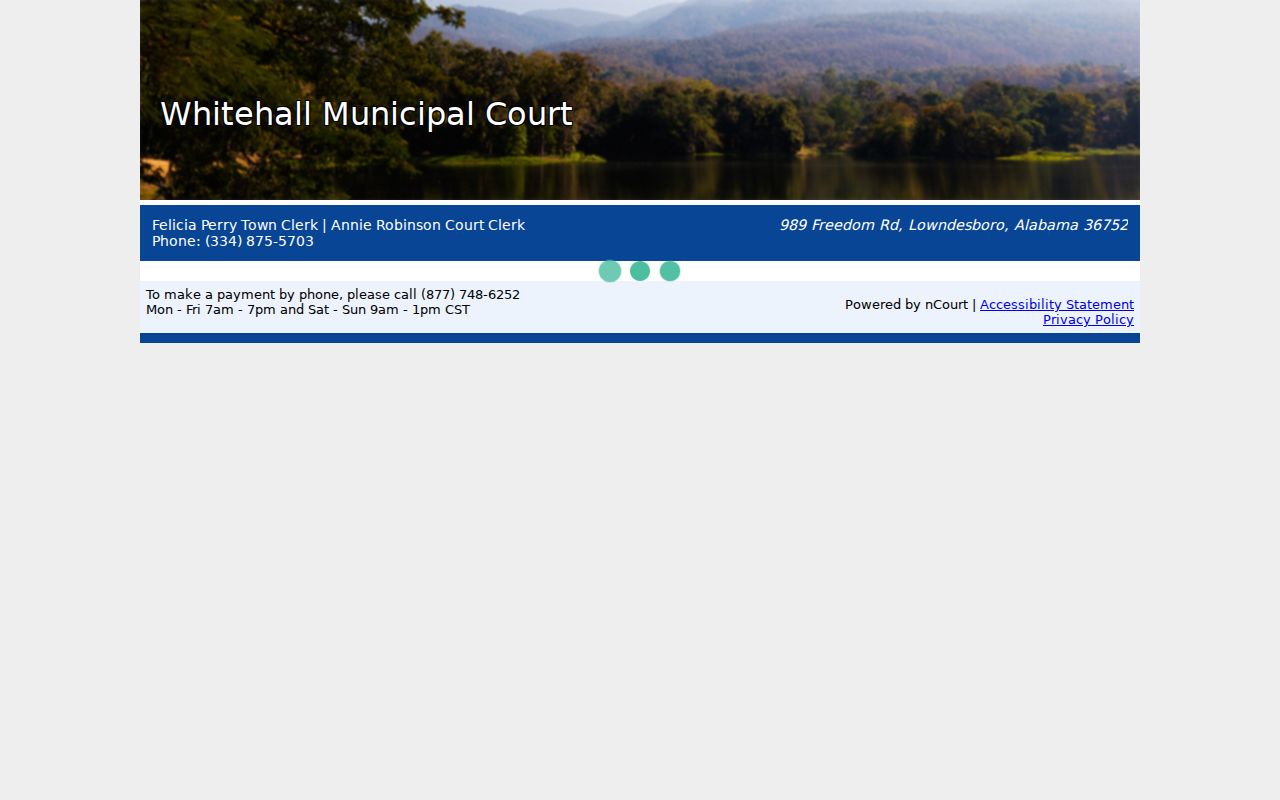
That official payment page backs the address warning. Treat it as a White Hall payment tool, not as a Lowndesboro court record or any kind of warrant search.
White Hall Warrant Types
In White Hall, the right label depends on the triggering event and the issuing authority. Not every city case is a municipal warrant.
| Type | Trigger | Authority to confirm |
|---|---|---|
| Municipal bench warrant | Missed city court or failure to comply | White Hall Municipal Court |
| Traffic-related warrant | Citation not answered as directed | Court named on ticket |
| Arrest warrant | Probable-cause complaint | Issuing judge or magistrate |
| Search warrant | Probable cause for evidence search | Issuing judicial authority |
A White Hall bench warrant grows out of a missed court obligation. An arrest warrant grows from a sworn accusation backed by probable cause. Each has its own path and its own issuing court.
Payment Portal Versus Warrant Status
A vendor can take an eligible court payment without publishing any warrant data. Finding an account by name may not reveal a bench warrant, a required appearance, a recall, or service, and a missing account may just mean a spelling difference, a transfer, timing, or an ineligible case. Before you pay anything, verify the court name, case number, and amount, and confirm the payment is legally allowed. Ask the clerk whether payment clears only a balance or also satisfies the court setting itself. Save the receipt. Then confirm the docket. Never send funds to White Hall just to test whether a name appears.
Note: Only the issuing court can state whether its process was recalled or quashed.
Inside a White Hall Warrant Record
A served warrant or municipal docket in White Hall can hold several distinct fields. No verified public numbering format exists for White Hall cases.
| Case or warrant number | Exact identifier copied from court papers. |
|---|---|
| Named person | Subject requiring careful identity confirmation. |
| Alleged offense | Charge or obligation, not proof of guilt. |
| Issuing court | The authority controlling current process. |
| Balance or bond | Separate figures with different legal effects. |
| Status | Active, served, recalled, or quashed as officially confirmed. |
An old docket can preserve warrant history. Ask whether active process remains now.
White Hall’s Municipal Boundary
Where the alleged misdemeanor happened matters. An offense inside White Hall belongs to municipal court. A felony component points to county jurisdiction. A county Sheriff contact alone does not turn a municipal docket into a county case.
Routing test: White Hall municipal misdemeanor › confirm municipal court; felony component or county-issued process › follow the named Lowndes court and Sheriff.
When papers conflict with a vendor label in White Hall, the official issuing document and the active court control.
How White Hall Warrants Fit the County System
White Hall Municipal Court keeps its own docket, while Lowndes Circuit and District Courts handle county cases. The Sheriff's official route asks anyone who suspects county process to appear in person.
Warrant flow: White Hall issuing court › responsible serving agency › service return and court record.
Turn to Lowndes County warrant records and county warrant lookup only once the city record points to a county authority. Alabama's Warrant Portal is limited to approved justice users.
A White Hall Traffic Scenario
A traffic citation may name White Hall Municipal Court or a different court, so read the paper before picking a portal. The Alabama Traffic Service Center handles eligible state traffic matters and warns that a ticket can take up to ten business days to appear. Paying can count as a guilty plea and waiver. Depending on the case, other eligible options include proof upload, added time, a trial, or a new date. A ticket that is missing online is still an obligation you must confirm. Lowndes warns that failing to dispose of a ticket or to appear can bring added costs, license suspension, bond forfeiture, and a warrant. Check the citation first, then act through the court it names.
White Hall Warrant Records and Public Access
Alabama Code §36-12-40 gives residents access to public writings, subject to legal, safety, security, and public-welfare exceptions. The Lowndes court says an arrest warrant stays non-public until served. Juvenile and youthful-offender records can remain protected.
Key rules:
Alabama public-record law does not create an unserved-warrant feed.
§12-14-51 addresses municipal magistrate powers.
§15-19-7 limits youthful-offender record access.
Correcting a White Hall Routing Error
If an earlier search treated the Lowndesboro address as the court's town, go back to the caption at the top of the vendor record. Check that the named court and case number match your citation. Then call a current, verified White Hall court contact before you pay or travel.
- Save the original citation and case number.
- Record which vendor page produced the contact.
- Ask the active court to confirm the current address and clerk.
- Request present warrant status from the issuing authority.
- Keep any receipt or signed judicial order.
That paper trail makes it easier to correct stale vendor data in White Hall without missing a real court obligation.
Resolving a White Hall Warrant
Start with the court that issued the White Hall warrant. Everything else follows from that. A lawyer can discuss surrender, bond, an appearance, or a motion to recall or quash. A recall withdraws the process. A quash sets it aside. Only the issuing court can take those actions. The clerk can state current procedure and provide accessible records, but cannot choose a plea or predict what a judge will do. After any payment or order, keep your proof and confirm the docket. If the matter is county-issued, follow the Lowndes court rather than a White Hall vendor screen.
Audit a White Hall Contact
When a vendor directory for White Hall shows phone numbers or mailing lines that clash, slow down and check on purpose. Begin with the court name and case number printed on the original citation. Compare the telephone, the mailing address, and the hours against a current official municipal notice. Then ask whoever answers to confirm two things: that the office really is White Hall Municipal Court, and that it controls your exact case number. A search snippet settles nothing in a White Hall warrant check. Keep three questions separate. Does the court show an unpaid balance? Does it show a required appearance or some other compliance step? Does the issuing authority show current warrant process? A payment vendor may answer only the first one. If staff cannot confirm status, ask which official office can, and write down the referral. Guard your card details too. Never send payment data through an email from an unofficial directory. Confirm the vendor from current court instructions, verify the case and amount, and read whether payment counts as a plea or waiver. Save the receipt. Ask whether further court action is required and whether any warrant-related order was entered. When you request access, name the record you want. A served warrant, a return, a municipal docket, and a recall order are separate documents. If the matter has a felony component, do not press the city vendor for county records; follow the county court named in the complaint or referral. That discipline keeps the Lowndesboro mailing line and stale fields from misrouting a White Hall case.
White Hall Records After Service
Once the warrant is served, ask White Hall Municipal Court for the public record by exact case number. Be specific. A served warrant, a service return, a docket entry, and a later order are four distinct documents. The court may release the public parts while withholding juvenile, youthful-offender, sealed, investigative, or safety-sensitive material. Service also moves the case along. Confirm the next setting. Confirm any bond terms. Ask whether the matter still belongs in municipal court, since a felony component can reroute it to a Lowndes County court. Do not read a vendor balance as a full account of what has happened. If an old vendor contact conflicts with the active court, keep both records. Note which official source corrected the data, and date the note. That note supports accurate follow-up. It also keeps the next payment or appearance from going to the wrong channel.